Sault Ste. Marie's Commitment to Reconciliation
The City of Sault Ste. Marie recognizes its important role in advancing reconciliation with Indigenous Peoples. As a municipal government serving the people of this region, the City delivers critical community services, supports regional infrastructure and planning, and actively works to foster relationships built on respect, recognition, and partnership.
The Summary of the Final Report of the Truth and Reconciliation Commission of Canada on Indian Residential Schools states:
“Reconciliation requires that a new vision, based on a commitment to mutual respect, be developed.”
This principle guides the City of Sault Ste. Marie in its reconciliation journey. We are committed to fostering a respectful and collaborative relationship with Indigenous communities, including Batchewana First Nation and Garden River First Nation, whose traditional territories include the land on which our city is situated.
Our commitment to reconciliation is embedded in both our internal culture and external initiatives. The City strives to view its policies, projects, and planning through a reconciliation lens, and to ensure early, meaningful, and ongoing engagement with Indigenous partners. This includes:
- Advancing truth-telling and education at the site of the former Shingwauk Residential School.
- Collaborating with local Indigenous communities on place-making, cultural programming, and land-use planning projects, such as Indigenous land acknowledgments throughout City facilities and events.
- Providing cultural competency and anti-racism training for City Council, staff, and community stakeholders.
- Participating in and supporting local events that promote Indigenous voices, such as National Indigenous Peoples Day, Orange Shirt Day, and the annual Gathering at the Rapids Pow Wow.
In 2021, City Council passed a resolution in support of the Truth and Reconciliation Commission’s Calls to Action, committing the municipality to ongoing learning and partnership. As part of this commitment, the city is also exploring ways to incorporate Indigenous perspectives in long-term planning, environmental stewardship, and youth and cultural programming.
Baawaating Advisory Circle
The Baawaating Advisory circle established in the summer of 2018, includes representatives from Batchewana First Nation, Garden River First Nation, Historic Sault Ste. Marie Metis Council, Metis Nation of Ontario, Youth Council, Indian Friendship Centre, Sault College Indigenous Students Sacred Native Student Council, Algoma University Anishinaabe Initiatives, and Children of Shingwauk Alumni Association.
The circle has been assigned the following mandate:
- to seek input along with the input from other First Nation leaders, representatives, and community partners on community plans
- to strengthen our own (advisory circle) relationships and the relationship between the First Nation community and the larger community
- to acknowledge and discuss truth and work towards reconciliation
- to seek advice, input, and guidance on how the city can implement the recommendations from the final report issued by the Truth and Reconciliation Commission
- to celebrate this area, its history, and the tremendous culture of the First Nation communities and people.
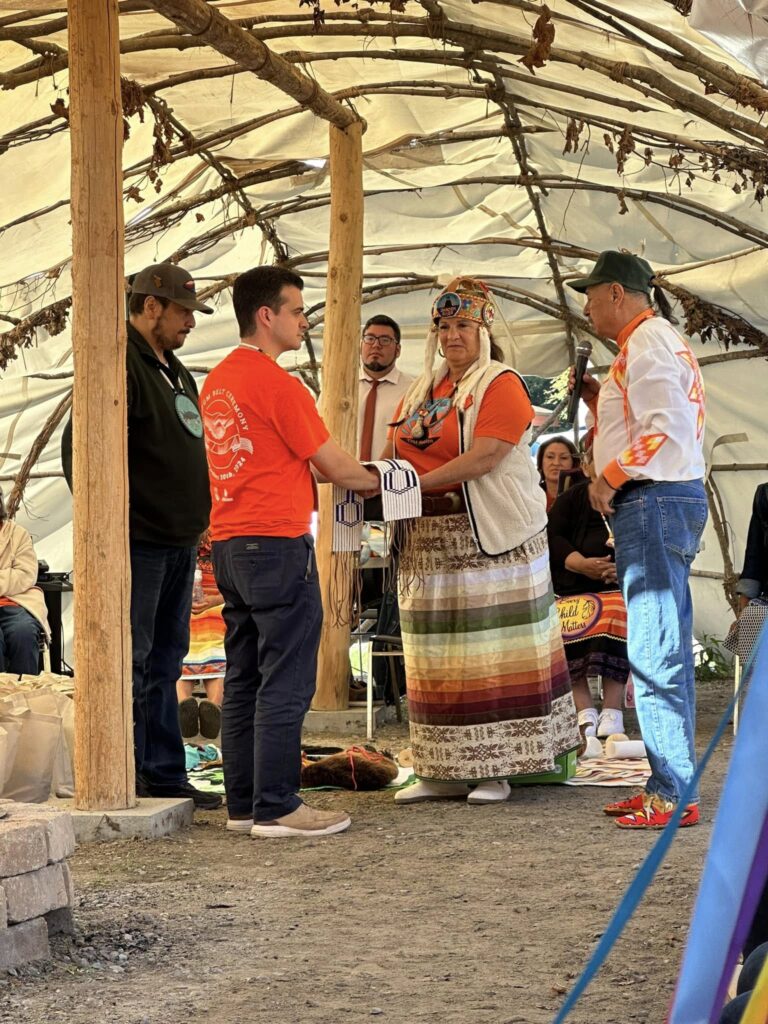
A Wampum Belt Ceremony
Garden River First Nation and the City of Sault Ste. Marie have completed a Cultural Competency project, made possible through the Community Support, Multiculturalism and Anti-Racism Initiative funded by the Department of Canadian Heritage. This initiative fostered deeper relationships and enhanced understanding between Garden River First Nation and Sault Ste. Marie.
Through this project, a comprehensive set of cultural competency workshops tailored for both Garden River First Nation and Sault Ste. Marie staff and leadership took place. The program has proven to be pivotal in strengthening our collaboration and deepening mutual respect and understanding.
A Wampum Belt Ceremony featured the exchange of a wampum belt and gifts between Chief Bell and Mayor Shoemaker, symbolizing the strong bond and mutual respect between the communities.
Friendship Accord
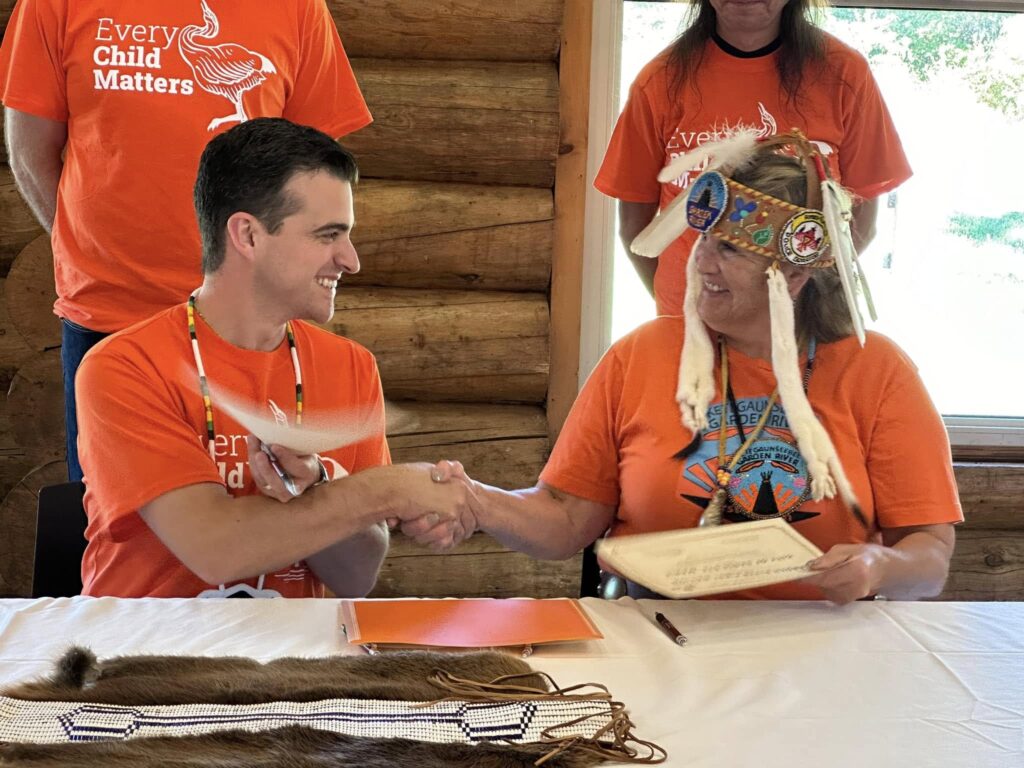
Garden River First Nation (Keetegaunseebee) and the City of Sault Ste. Marie (Bawaating) have graduated from the First Nation-Municipal Community Economic Development Initiative (CEDI) program with the historic signing of their Friendship Accord.
The graduation and signing ceremony mark the culmination of a transformative two-year journey of collaboration and trust-building under CEDI, a national program co-delivered by the Federation of Canadian Municipalities (FCM) and Cando. As one of only eight partnerships selected for Phase 3 of the program, Garden River First Nation and the City of Sault Ste. Marie have worked diligently since early 2023 to foster Reconciliation, strengthen their partnership, and develop shared economic and cultural goals.
The Friendship Accord represents a historic commitment to ongoing collaboration and mutual respect between Garden River First Nation and the City of Sault Ste. Marie. Rooted in the shared stewardship of the St. Mary’s River, the Accord incorporates cultural and environmental priorities while outlining actionable steps for economic development, anti-racism initiatives, and youth engagement. Both communities emphasize that this is not the end of their partnership but the beginning of a deeper journey of unity and shared vision.
Reflections on September 30
Today, as I sit and reflect on this day, many emotions and many words come to mind.
I hold the responsibility of seven generations.
I am Anishnaabekwe.
A daughter.
A mother.
A wife.
A sister.
An aunt.
A learner.
A teacher.
A supporter.
A human being.
I am here because of those who came before me.
The future of Anishnaabe culture, language, teachings and traditions exists because our ancestors stood strong. They were resilient. They were caring. They were brave. They carried their responsibilities through times when the world around them tried to take those responsibilities away.
Today asks us to look at the past, to acknowledge the present, and to carry responsibility for the future.
I sat outside by the water today.
I listened to the water move.
And I thought about the Anishnaabe people before contact.
Life on the land.
Life with the water.
Life with the animals.
Life guided by relationships, responsibilities, ceremony and connection.
I thought about how beautiful life was—and how much knowledge existed within our people long before anyone wrote it down.
Then I reflected on today.
The voice of the Anishnaabe.
The resilience of the Anishnaabe.
The humility.
The strength.
The bravery.
Our Elders speak about the seven generations, and the teachings behind this concept go deep into the Anishnaabe understanding of respect and responsibility. We are not only responsible for ourselves. We carry responsibility for those who came before us and for those who have not yet arrived.
Our ancestors did not only stand up for their families and communities.
They stood up for people they would never meet.
They stood for children whose names they would never know.
They protected teachings for generations they would never see.
They carried the language.
They carried the stories.
They carried the songs.
They carried the medicines.
They carried the ceremonies.
They carried us.
Anishnaabe Peoples continue to stand for the teachings, for the bloodline, for the children and for the generations still to come. We listen to our spirits. We gather in ceremony. We put our tobacco down. We return to the land and the water. We remember who we are.
And today, as I sit and reflect, I think about my children.
I think about how proud they are of who they are.
I think about the fact that they can learn their culture, practice their traditions, put their tobacco down and speak about being Anishnaabe without having to hide who they are.
I think about my parents, who are learning and reclaiming pieces of who they are.
I think about our people.
And I think about how much was sacrificed.
I think about the communities that mourned.
The families that experienced unimaginable trauma.
The children who were taken.
The languages that were silenced.
The ceremonies that were restricted.
The families who continue to carry the impacts of generations of pain.
And I think about a question that is difficult to sit with:
Who would we be today if our ancestors had stood down?
But they didn’t.
They stood.
They survived.
They loved.
They protected.
They remembered.
And because they did, we are here.
Today, as I sit and reflect on this day, I am grateful.
I am proud.
I am Anishnaabe.
I feel with love.
I share with truth.
I stand with bravery.
I think with wisdom.
I reflect with humility.
I speak with honesty.
I live with respect.
These teachings carry me through my days.
They help me understand.
They help me forgive.
They help me learn.
They help me move forward.
Truth and Reconciliation means more than remembering history.
It means being willing to understand.
It means being willing to listen.
It means being willing to learn.
It means being willing to acknowledge truths that may be uncomfortable.
It means creating space for the voices and lived experiences of Indigenous Peoples.
And it means recognizing that reconciliation is not something that happens in one day. It is a responsibility we carry forward.
Anishnaabe Peoples do not wish harm upon anyone.
We hope that people find truth in their lives.
We hope they find understanding.
We hope they find the courage to listen.
We hope they find a relationship with this land and water that is rooted in respect.
Today, as I sit and reflect on this day, I hope everyone takes a moment to look around.
Look at how beautiful this land is.
Listen to how powerful the water is.
Watch the animals.
Feel the wind.
Look at the trees.
Remember the medicines.
Recognize everything Mother Earth has provided to the people.
For the Anishnaabe, these are not simply things around us.
They are part of our relationships.
They are part of our teachings.
They are part of who we are.
Understanding what Truth and Reconciliation represents is only the first step.
Listening is another.
Learning is another.
But perhaps the deeper journey begins when we allow ourselves to see the world differently—to understand that there are ways of knowing, ways of being and ways of relating to the land, water, animals and one another that have existed here since long before the arrival of settlers.
Today, I remember.
I honour those who came before me.
I carry their teachings.
I carry their strength.
I carry their love.
And I carry the responsibility of seven generations.
For those behind me.
For those beside me.
And for those who are still to come.
Miigwech to our ancestors.
Miigwech to our Elders.
Miigwech to our families.
Miigwech to our children.
And miigwech to the land and water that continue to teach us, if we are willing to listen.
Today, I sit.
I listen.
I reflect.
I remember.
And I carry forward.
I am Anishnaabekwe.
Signed,
Kaitlyn Neveu
Anishnaabe E-Wiidookaaged